
When a room has echo, or sound is reverberating off a venue’s walls, you likely will first look up. Ceilings offer the largest, and often untreated, reflective surface in a room. This can cause significant echoes in a variety of rooms.
High school band rooms without any ceiling treatment can sound harsh and chaotic. Large concert halls will have higher reverberation, leading to a lack of early sound energy. Even a smaller home theater can be subpar without the right ceiling installations. Sounds become lost, and the performer’s or actor’s voice on the screen won’t be clear.
But while ceiling treatments are often part of the solution, they aren’t going to solve the entire issue. Today’s modern, open-plan spaces need a holistic approach to acoustics. This looks like combining ceiling and wall treatments to handle reflections from multiple angles. Here is why ceiling treatments alone are insufficient to solve a space’s acoustic issues, and how vertical surfaces and furnishings play a growing role in acoustic planning.

Why Ceiling Fixtures Can’t Control Reverberation Alone
Regardless of how vast a room’s ceiling is, sound doesn’t just float up and disappear into thin air. It reflects off every surface within a room, including the walls and windows. Acoustic ceiling installations will address some of the problems, but sound will continue to echo between the vertical walls. Ceiling fixtures alone fail for the following reasons.
The “Six-Surface” Problem
Sound doesn’t play favorites. Just implementing a ceiling treatment, doesn’t mean that sound will reverberate just off that one surface. All six surfaces of a room — the four walls, floor, and ceiling — are up for fair game. With this, flutter echoes, standing waves, and excessive reverberation are all possible, even if the ceiling is properly treated.
Insufficient Surface Area
Yes, a ceiling may be the widest and most expansive space, but the surface area is still insufficient compared to what is needed for the room. Acoustic systems take every wall into consideration, as well as flooring surfacing materials. To greatly reduce reverberation time, a large quantity of absorbent material is needed and it can’t just be placed on the ceiling.
Room Height
In grand spaces, such as massive concert halls or theaters, sound travels longer distances before hitting the ceiling. This means a longer lead time before a sound hits a surface, which increases the time for the sound to dissipate. Ceiling-only treatments can’t tackle this problem alone.
Geometric Constrictions
Some ceilings aren’t perfectly flat. There are different aesthetic shapes and materials used to create different effects. This makes finding the right ceiling acoustic solution even trickier. And, in some instances, the wrong installations can lead to worsening sound diffusion.
A Holistic, Spatial Strategy to Acoustics
Taking a step back from ceiling-only installations, there is a growing awareness of the need for holistic, spatial strategies. This approach moves beyond traditional noise control and actively works to enhance the acoustical experience of the space. A spatial strategy includes vertical surfaces as well as furnishings in creating a comprehensive design that is both aesthetically pleasing and acoustically sound.
Below are some key components in terms of creating a holistic acoustic strategy.
Treat Sound as an Active Design Element
Rather than a byproduct, sound should be considered as an active design element. This means mapping the space with the purpose of creating the clearest sound. A professional team can help with spatial configuration and mapping to suggest a variety of sound-absorbing surfaces. Soft furnishings, plush carpet, and acoustical porous materials may all be recommended depending on the room’s size and purpose.
This treatment is important in modern-day living as open-floor plans and vast spaces are becoming normalized in different areas. Workplaces, for example, are leaning toward open designs in order to foster a sense of adaptability and collaboration. But without the right acoustic treatment, office noise can quickly become an issue, reducing productivity and increasing stress.
Think About The Acoustic ABCs
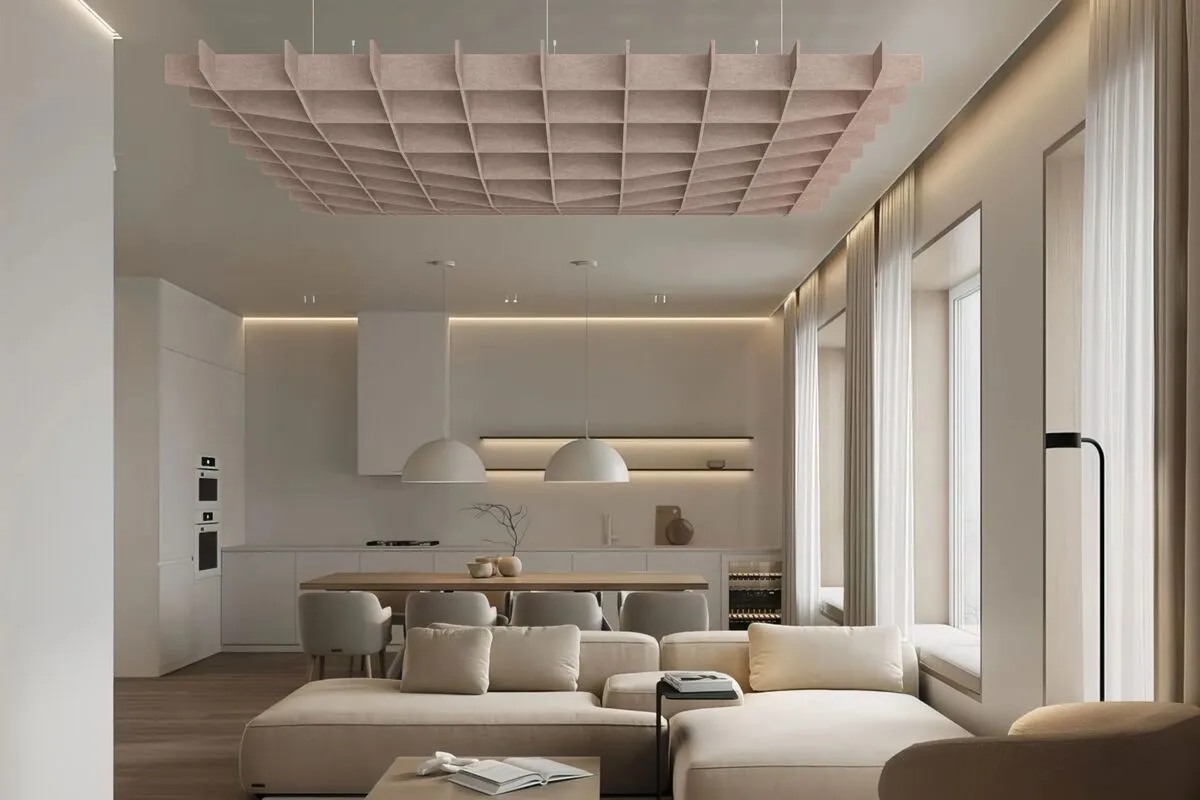
The move beyond simple soundproofing means thinking about the ABCs of acoustic design. “A” stands for absorption. Porous materials, like acoustic wall panels, ceiling clouds, curtains, and carpets, help reduce reverberation as well.
“B” stands for blocking. Physical barriers can help reduce noise between different sections of a room. Think about large panels or partitions, as well as furnishings to break up a room. A long sofa can act as a divider within a space, and help with the acoustics as well.
“C” stands for covering, or sound masking systems. Natural sounds, such as small water features or white noise machines, can help create a consistent soundscape to help drown out other noises and improve focus. Of course, these types of fixtures only work well in some spaces, such as open classrooms or offices.
Choose Materials with Care
The fabrics and materials you select within a space can enhance a room’s sound quality. Natural materials like wooden diffusion systems or plants can help with sound absorption. Soft upholstered furniture and thick rugs can dampen noise, reducing reverberations and overall ambient noise levels. Polyurethane or melamine foam panels are ideal options for absorbing sound in a recording studio or home theater. In general, a wide variety of materials is best suited to manage sound behavior.
The Case for Full-Room Acoustic Planning
While ceiling acoustic systems can be beneficial, remember that they aren’t going to solve all of your sound issues. Rather, including different wall panels, furnishing selections, and physical barriers is a holistic, spatial strategy that will enhance acoustics and create a more comfortable, functional space.